
Make Your Agents and Systems Agentic With The Cortex Memory Framework
Every AI tool you've ever used has amnesia.
You build a brilliant AI agent. Day one, flawless. Day two, total amnesia. If that were a human employee, you'd fire them on the spot. With AI agents, most people just accept it.
That's not a bug. That's how most AI works by default. Every new session is a blank slate. No memory of what you built, what you decided, what you discussed. Fine for a simple chatbot answering one-off questions. A dealbreaker for an agent that's running part of your business.
I've been building agentic AI systems for a few years, and this is the single failure mode I see over and over. Not a broken prompt. Not a missing tool. Memory. The agent doesn't know who it is, what it's done, or what it learned yesterday.
I built The Cortex to fix exactly that.
What The Cortex actually is
The Cortex is a memory framework you bolt onto any AI system. A chatbot. An agent. A voice bot. A coding assistant. Anywhere intelligence needs continuity.
It gives your AI the ability to remember everything it learns. Across sessions, across days, across projects. And it uses that accumulated knowledge to get genuinely smarter over time.
It's not a database. It's not a chat log. It's not a search layer bolted onto the side of your app.
It's a four-layer pipeline that mirrors how human expertise actually develops. Experience becomes observation. Observation becomes knowledge. Knowledge becomes intuition. And intuition makes the next experience more productive than the last.
Here's the simplest way to think about it.
Without The Cortex: every session is Day 1. The AI knows nothing about your business, your preferences, your history, or what worked last time. You start from scratch. Every. Single. Time.
With The Cortex: every session builds on every previous session. The AI remembers what you told it, what it learned, what worked, what failed. Session 50 feels like working with a colleague who's been on your team for months. Because, in a meaningful way, it has been.
That's the difference between a tool and a team member.
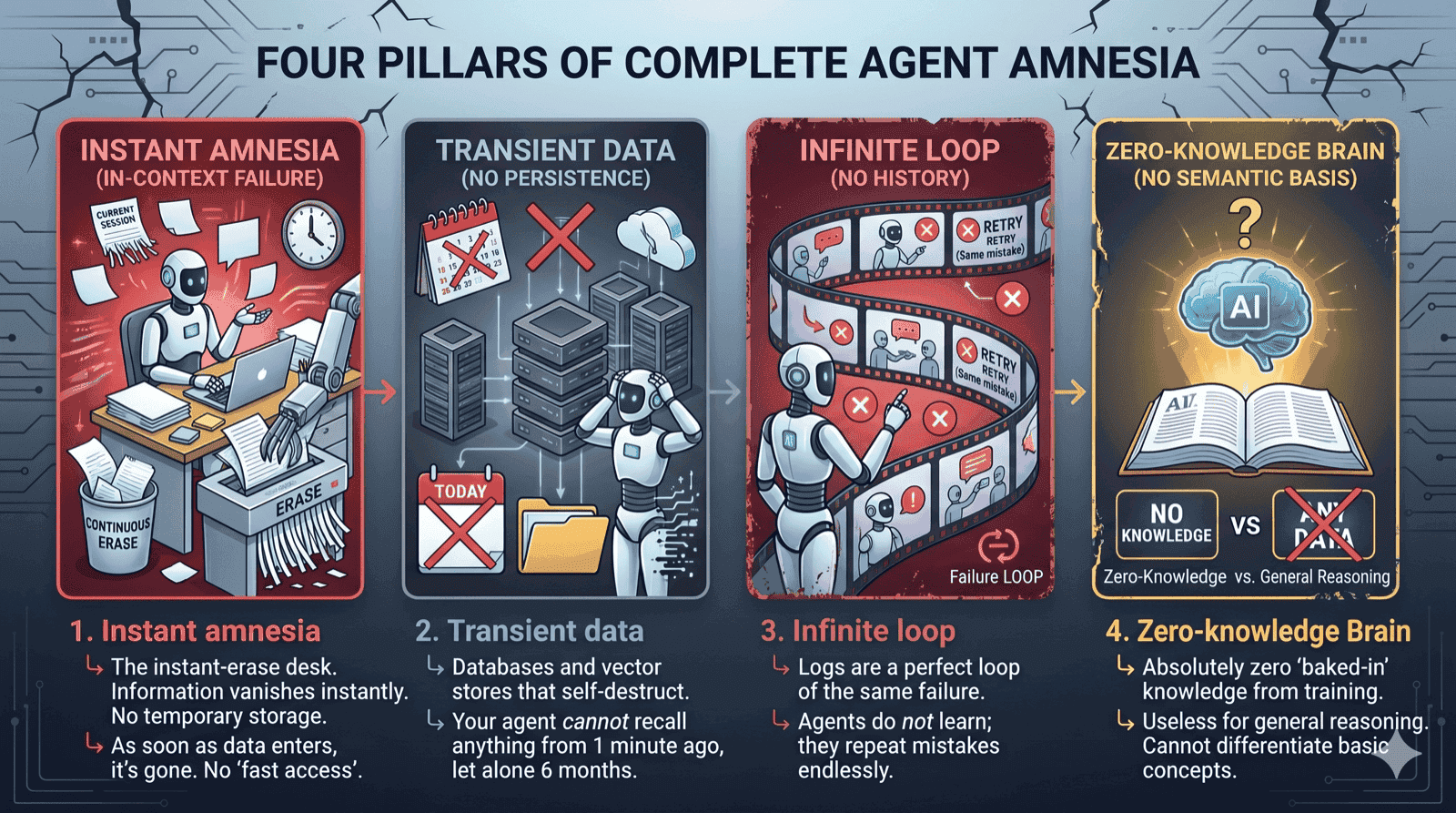
How The Cortex works: four layers of memory
You don't need a technical background to understand this. The Cortex works the way your own memory works. Just structured for machines.
Layer 1: Semantic memory. What it knows.
This is the AI's foundation. Its education. The things it knows before it ever meets your project.
Think of it like the difference between hiring a generic engineer and hiring one who's read your entire company wiki before their first day. Same person. Dramatically more useful. Because they have context.
Semantic memory includes everything the AI learned during training, plus the specific knowledge you give it about your work. Your documentation. Your brand voice. Your decision rules. Your conventions. The Cortex loads all of this into every conversation automatically. The AI sees it before you even ask your first question.
Layer 2: External memory. What it's stored.
This is the AI's long-term memory. The persistent record of everything it has ever learned about your work.
Think of it as the AI's notebook. But instead of sitting on a shelf, it lives in an external database, so it can't get lost, corrupted, or wiped when you restart your computer or switch machines.
When the AI learns something worth remembering, a pattern that works, a preference you have, a decision you made, it writes that knowledge to the database. And if the database is temporarily unreachable, The Cortex doesn't panic. It saves the memory locally and syncs it up the next time the connection is back. No data lost. It just works.
Here's the key insight. External memory is the single source of truth. Whatever computer you're on, whatever session you're running, the knowledge is there. Always available. Never forgotten.
Layer 3: Episodic memory. What it's experienced.
This is where The Cortex becomes something truly different.
Episodic memory captures what actually happens during your work sessions. Not just what you said. What the AI did. What tools it used. What errors it hit. What solutions it found. What quality score its output earned.
Think of it as the AI's work diary. But unlike a diary that sits on a shelf, this one gets actively analyzed. Significant interactions get flagged and recorded. Quality outcomes get tracked. If a response scored 8.5 out of 10, that approach gets recorded as a proven pattern. If something scored 3 out of 10, that gets recorded too. So the AI never makes the same mistake twice.
This is the learning loop. The AI isn't just storing information. It's building experience. And experience is what separates a junior hire from a senior one.
Layer 4: In-context memory. What it's thinking about right now.
This is the AI's working memory. The active context it's using during the current conversation.
At the start of every session, The Cortex does something remarkable. It searches through all of its stored memories, potentially thousands of them, and loads the most relevant ones into the AI's active context. Not the most recent. The most relevant. Chosen by semantic search, which understands meaning, not just keywords.
If you're working on customer onboarding today, The Cortex pulls in memories about past customer flows, onboarding decisions you've made, and your preferences around messaging. Even if those memories were written weeks ago and never used the word "onboarding."
It's like starting a meeting where someone has already pulled the most relevant files from the archive and placed them on your desk. You don't have to ask. You don't have to search. The right context is just there.
How the four layers flow together
The magic of The Cortex isn't in any single layer. It's in how they flow into each other.
You work with the AI. Episodic memory captures what happened. External memory stores it permanently. Between sessions, the memories get consolidated and refined. Next time you sit down, in-context memory loads the most relevant knowledge into the AI's active awareness. Semantic memory makes that knowledge actionable. And the AI is smarter than it was yesterday.
This is a compounding loop. Every session feeds the next one. Every experience becomes knowledge. Every piece of knowledge makes the next experience more productive than the last.
In human terms, this is how expertise works. A surgeon doesn't just know anatomy. They remember every surgery they've performed. That experience is stored in their long-term memory. And when they walk into the operating room, the most relevant knowledge surfaces automatically. That's why a surgeon with 20 years of experience is qualitatively different from a first-year resident. Not because they're smarter. Because they've accumulated.
The Cortex gives AI the ability to accumulate.
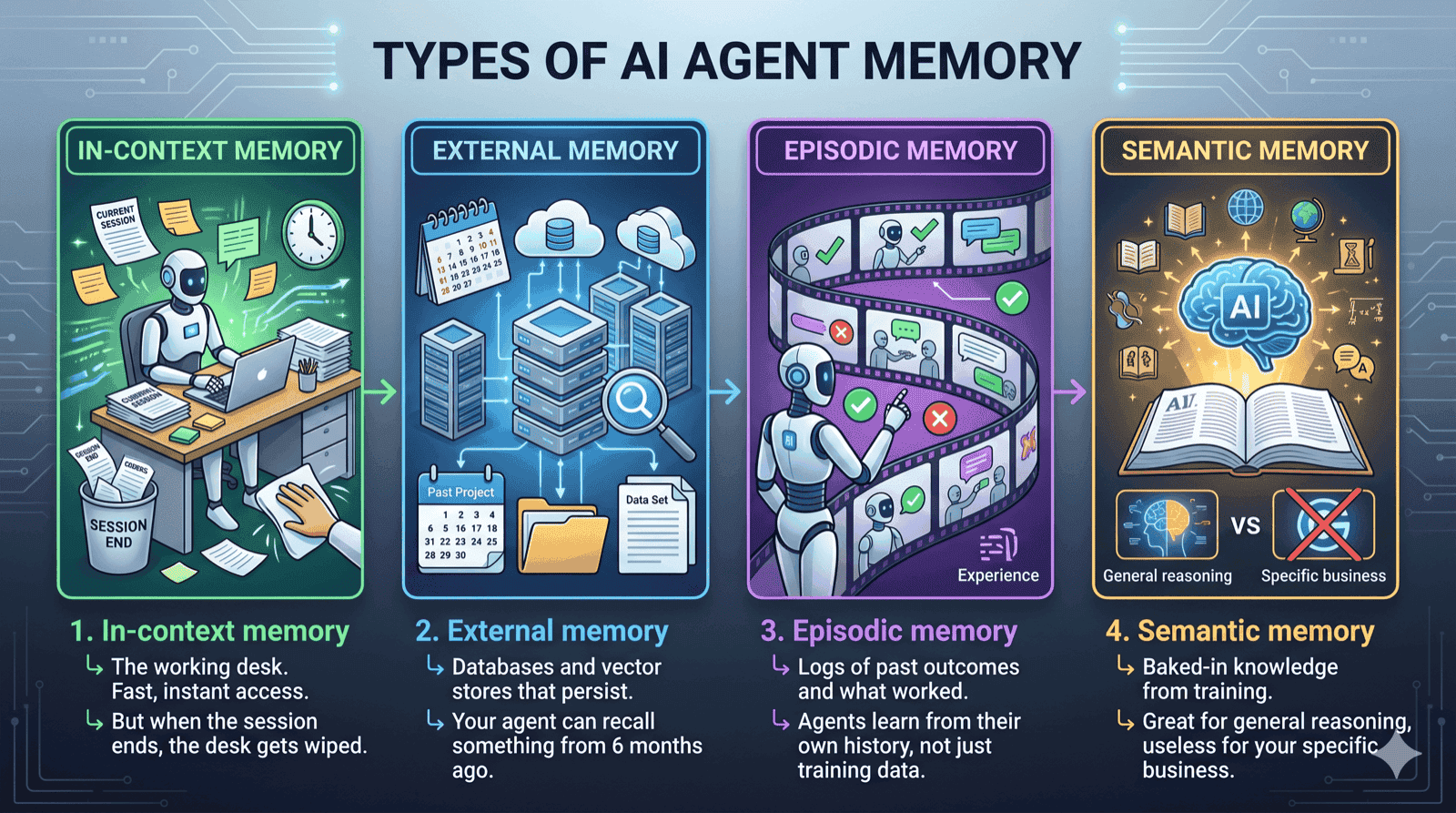
What The Cortex isn't
The Cortex isn't magic. It's architecture.
Session 1 won't feel remarkable. The Cortex needs data to learn from, and data takes real work sessions to generate. You'll start feeling the compounding effect around session 5 to 10. By session 30, you'll notice the difference. By session 100, you won't want to work without it.
The Cortex also isn't a substitute for thinking about what's worth remembering. Every memory has a minimum quality threshold. Thin memories are worse than no memories. A memory that says "login form completed" tells your AI nothing. A memory that captures the actual decision, "used a validation library because the previous sprint rejected custom regex," becomes something the AI can use for years.
And The Cortex isn't a monolith. You can bolt it onto a chatbot and use one layer. You can bolt it onto an agentic system and use all four. The point isn't to deploy everything at once. The point is to know what layer you're at, and why.
Where The Cortex fits
The Cortex is framework-agnostic. It bolts onto anything. Here's where it shines.
Your chatbot or customer-facing AI. Every customer deserves an experience where the AI remembers their last conversation, their preferences, and the decisions you made together. Without memory, every customer interaction is a stranger meeting for the first time. That's why most chatbots feel frustrating to use.
Your agentic system. An agent without memory is a brilliant consultant with amnesia. Fine for a one-off task. A disaster for anything you want to run part of your business on. The Cortex is what makes an agent actually agentic.
Your coding assistant. I use Claude Code every day. Without The Cortex layered on, Claude is a brilliant engineer who shows up every morning having forgotten your entire codebase, your conventions, and yesterday's decisions. With The Cortex, Claude remembers. And compounds. Every session is smarter than the last.
Your voice bot, your copilot, your internal tool. Anywhere intelligence needs continuity, The Cortex is the layer that turns a stateless tool into a stateful partner.
The short version
- The Cortex is a four-layer memory framework that bolts onto any AI: chatbots, agents, voice bots, coding assistants. It turns stateless AI into stateful intelligence.
- The four layers mirror how human expertise develops: semantic (what the AI knows), external (what it's stored), episodic (what it's experienced), and in-context (what it's thinking about right now).
- Without memory, every AI session is Day 1. With The Cortex, every session builds on every previous one. That's the difference between a tool and a team member.
Every agentic system I've shipped that actually mattered had memory. Every one that fell apart after a month was missing it.
Over the coming posts I'll unpack what each layer looks like in practice, how memories get consolidated so your database doesn't bloat, how knowledge learned on one project flows to the next, and how The Cortex handles itself when something goes wrong.
For now, one thing. Every AI you're using today has amnesia. Once you see what memory actually earns you, you won't build without it again.